Destination Archéologie

Shaping a visual narrative of archaeology past, present, and future

View
Client:   MCAH Lausanne Year:   2025 Location :   Lausanne, CH Services:   Exhibition graphics Image credit:   Mathieu Bernard-Reymond

In 2024, scenographers Curious Space and Praline collaborated on the winning pitch for the next temporary exhibition at the Musée cantonal d’archéologie et d’histoire (MCAH) in Lausanne, Switzerland. The exhibition explores the origins of archaeology in the late 19th century, tracing its development from 1798 while projecting possible futures for the discipline.

Rather than presenting archaeology as a field rooted solely in the past, the exhibition invites visitors to understand how archaeological practices, methodologies and interpretations continue to evolve today

WHEN EXHIBITION GRAPHICS SUPPORT SPACE PLANNING

A central challenge was the exhibition’s scale and density. Spanning 1,200 m² and encompassing artefacts from all regions and eras, the space required a clear structure to guide visitors through multiple timelines without becoming overwhelming. Establishing clarity and orientation across the visitor journey was therefore fundamental to the design.

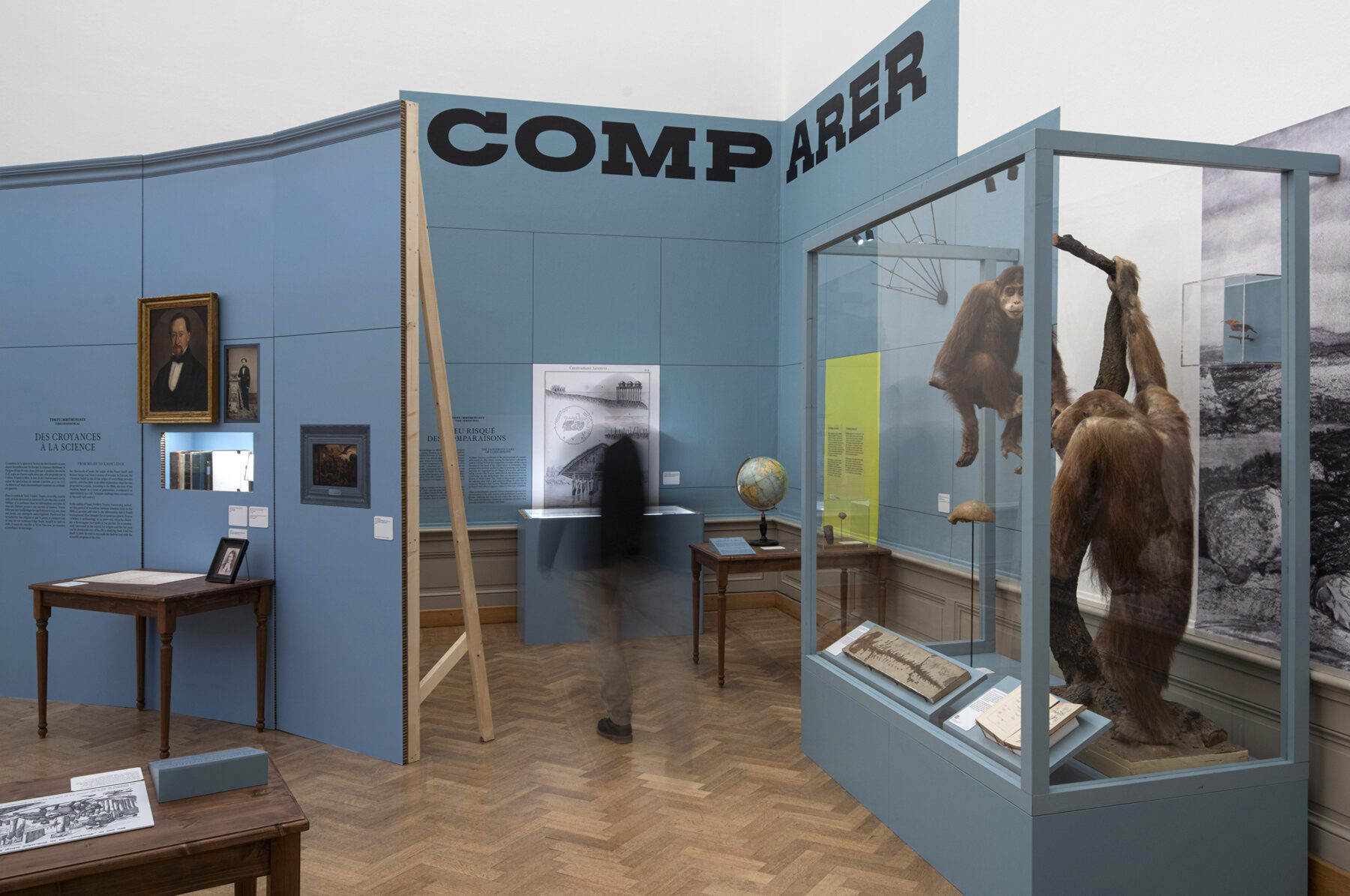
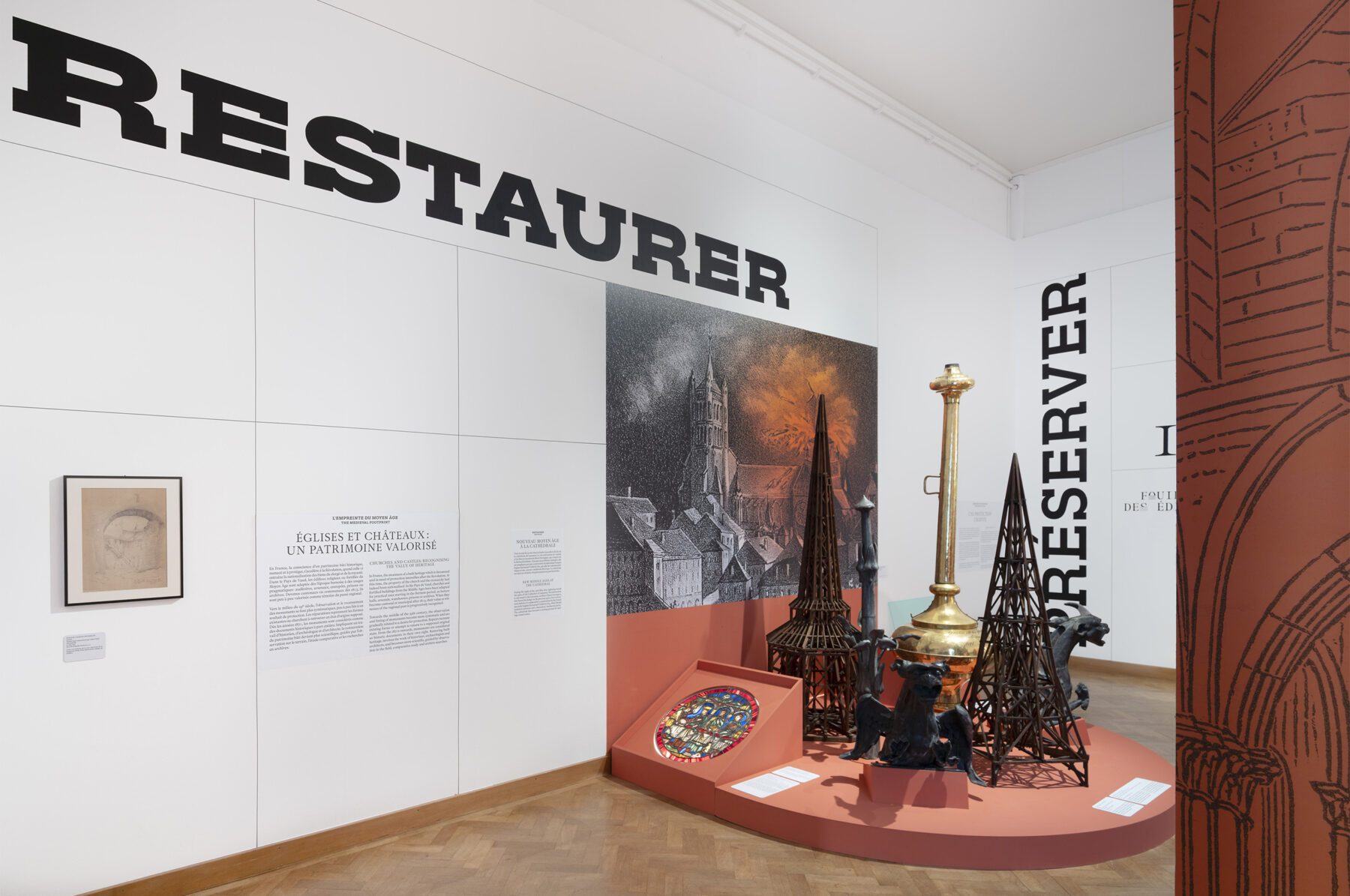
Close collaboration with Curious Space shaped the project, with spatial planning and content evolving alongside the graphic system to ensure coherence between the two. The exhibition is organised around six colour-coded themes, with sub-sections signposted through key action words distributed across the gallery walls.

PAST MEETS PRESENT

Praline developed two distinct graphic languages to support navigation between 19th and 21st century narratives.

The first draws on 19th-century typographic influences, shaped by technical advances that enabled larger scales, new type families and more expressive letterforms, alongside classical traditions rooted in ancient Greece. This language is reinforced by a colour palette inspired by the period.

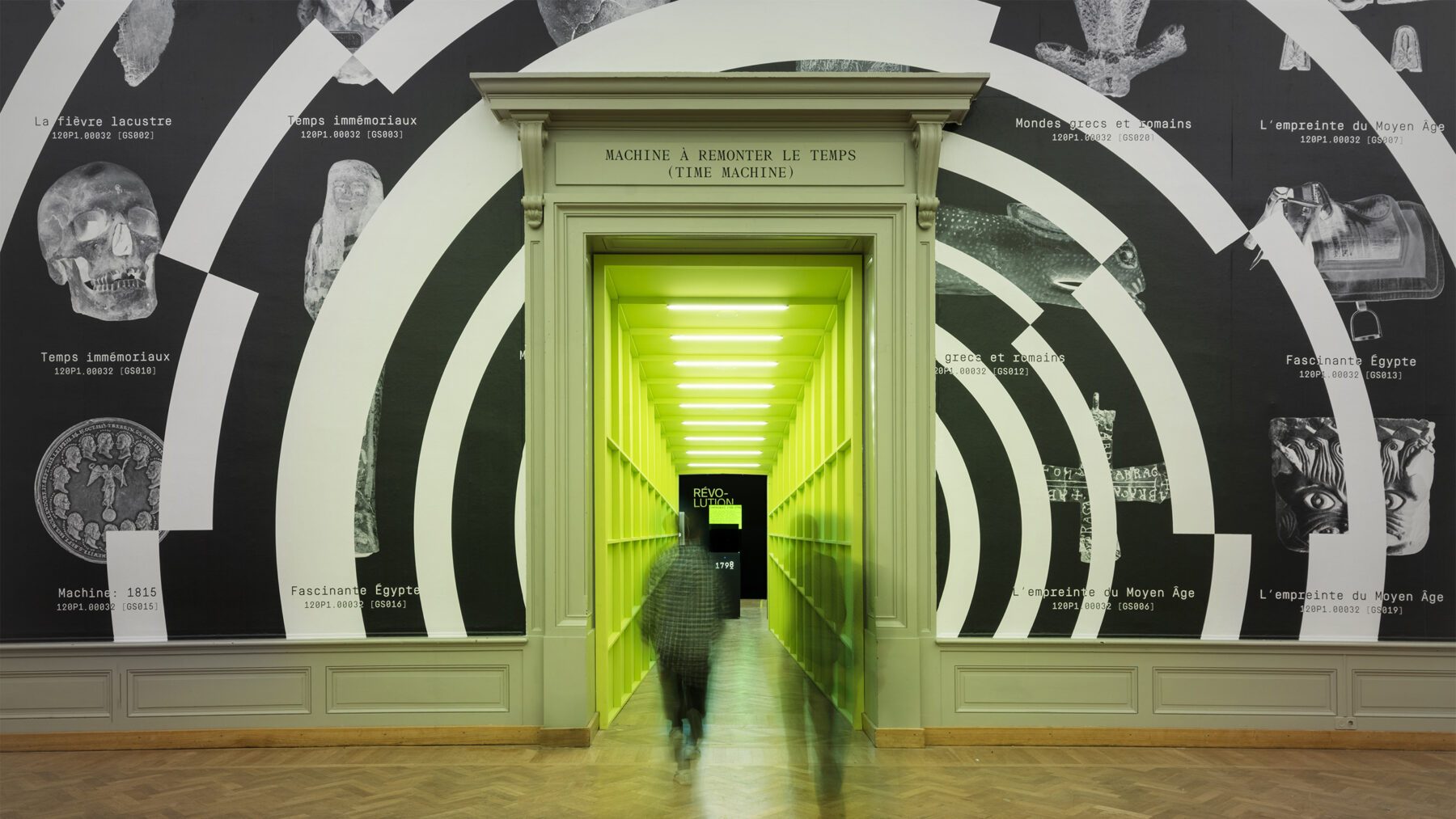
The second embodies the 21st century, conceived in deliberate contrast to the historical system. Present- and future-focused content is set in a neutral visual language using Suisse International, with minimal typographic styling and a vivid lime colour acting as a visual beacon.

 

MAKING COMPLEX CONTENT ENGAGING FOR ALL

Throughout the exhibition, graphic elements play a central role in mediating between scholarly content and public accessibility. Interpretive elements such as large-scale imagery, timelines, maps, colours blocks, as well as a bespoke children trail graphics and booklet were designed to support multiple levels of reading, enabling both quick comprehension and deeper engagement with the material.

Curious Space proposed the introduction of a series of “time machines”, positioned at key moments along the route. These interventions anchor visitors in a specific year before they encounter the archaeological discoveries of that period. Praline developed a graphic extension of the 21st-century language specifically for these threshold spaces, giving them a simple, machinelike aesthetic that reinforces their immersive and transitional role within the exhibition.

EXTENDING THE EXPERIENCE BEYOND THE MUSEUM

In parallel, Praline was commissioned to develop the marketing campaign for the exhibition’s 14-month run. The brief called for a visual approach that moved away from object-led communication (a strategy previously used for past exhibitions) in favour of one that conveyed the experience of the exhibition itself.

The museum also aimed to reach new audiences, particularly Art museums visitors and people coming from beyond the city. In response, the campaign focuses on suggestion rather than explanation, inviting curiosity instead of revealing content outright. An unusual graphic language was developed for this archaeological and historical museum context, positioning the exhibition as a contemporary, immersive experience.

“We value every opportunity to work with our long-term collaborators, Praline. They are exceptional on both a personal and creative level. Their imaginative approach to the design process, combined with a deep understanding of three-dimensional space, consistently elevates our spatial design and experiences. Throughout the process, they are reliable, efficient, and deeply committed to delivering work of the highest production quality.”

Anna Jones, Design Director, Curious Space